
-
By jagdambaengineering_admin
-
March 5, 2026
- 0 Comment
Granite vs Marble Polishing Process: Understanding the Key Differences
Granite and marble are among the most widely used natural stones in construction and interior design. While both stones require polishing to achieve a smooth and glossy finish, their polishing processes differ significantly due to their unique physical properties.
Understanding these differences is essential for stone processing industries and machine manufacturers.
Nature of Granite and Marble
Granite is a hard, dense stone composed mainly of quartz and feldspar minerals. Because of its hardness, granite requires stronger abrasives and higher polishing pressure.
Marble, on the other hand, is a softer metamorphic stone made primarily of calcium carbonate. Its polishing process is relatively smoother and requires gentler polishing methods compared to granite.
Polishing Stages
Both granite and marble polishing involve multiple stages that gradually improve surface smoothness.
The process typically begins with rough grinding, where coarse abrasives remove uneven surfaces. After that, medium abrasives refine the surface, and finally fine polishing tools create a high-gloss finish.
However, granite polishing requires more stages due to the stone’s hardness, while marble polishing may require fewer steps.
Role of Polishing Heads
Polishing heads play a critical role in both granite and marble processing. These heads hold abrasive tools and apply controlled pressure on the stone surface.
For granite processing, polishing heads must be strong enough to handle higher pressure and harder abrasives. Marble polishing heads, while still durable, often operate under slightly lower pressure conditions.
Achieving High Gloss Finish
The goal of both processes is to produce a smooth, reflective surface. The quality of the polishing head significantly influences the final result.
Precision-engineered polishing heads help ensure that abrasives maintain consistent contact with the stone surface. This consistency eliminates surface defects and enhances gloss quality.
Production Efficiency
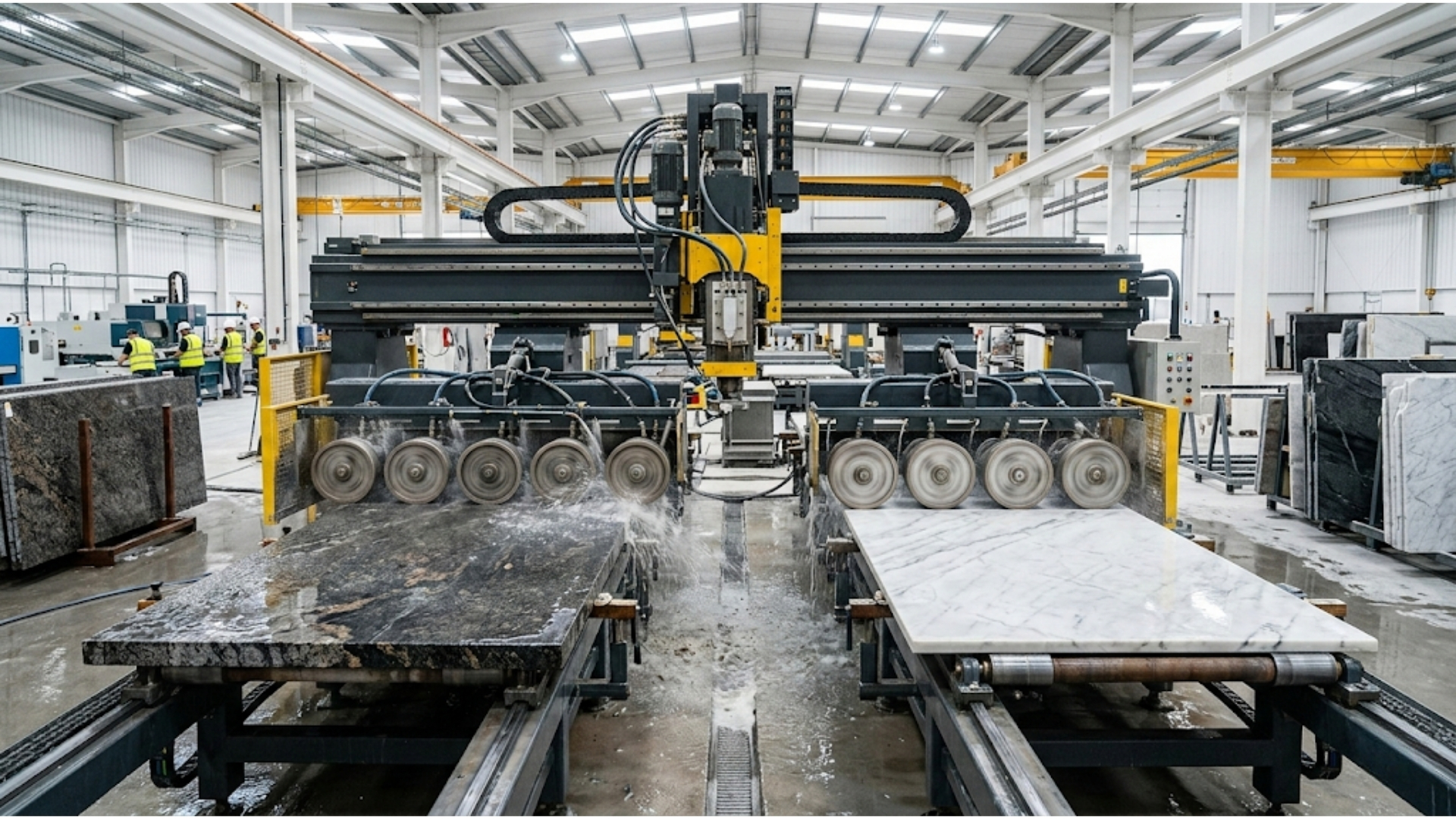
Stone processing plants rely on automatic polishing lines to achieve high production output. Efficient polishing heads ensure smooth machine operation, reduce vibration, and extend the life of abrasive tools.
Conclusion
Although granite and marble polishing share similar principles, the differences in stone hardness and structure require specialized polishing approaches. With the right polishing heads and machine configuration, stone processing industries can achieve excellent finishing results for both materials.